
Pattern imprinted concrete sold hard across Greater Manchester from the late 1990s through to the credit crunch, and a lot of those drives are now 15 to 20 years old. We get calls about them most weeks - Boarshaw, Rhodes, Hollins, the estates off Hollin Lane - and the description is nearly always the same. It has gone grey. There is a crack. It is like an ice rink when it rains. The owners usually assume they have been sold a dud. Some have. Plenty have not, and what they are actually looking at is a surface that needed a coat of sealer every three to five years and never got one in a region that takes roughly 850mm of rain a year. This is a straight run through what fails on an imprinted drive, which faults are cosmetic and which are structural, and what your realistic options are when yours has reached the end.
What is actually under a printed concrete drive
Understanding why it fails means knowing how it was put down. Printed concrete is not slabs or blocks. It is one continuous pour, typically 100mm thick over 150mm of compacted stone, with steel mesh or fibres through it. While it is still soft, a dry colour hardener is floated into the top few millimetres, a powdered release agent in a second colour is scattered over it, and rubber mats are pressed in to give the texture. A day later the installer cuts control joints into it. A few days after that the release powder is washed off, which reveals the two-tone colouring, and the whole lot gets sealed.
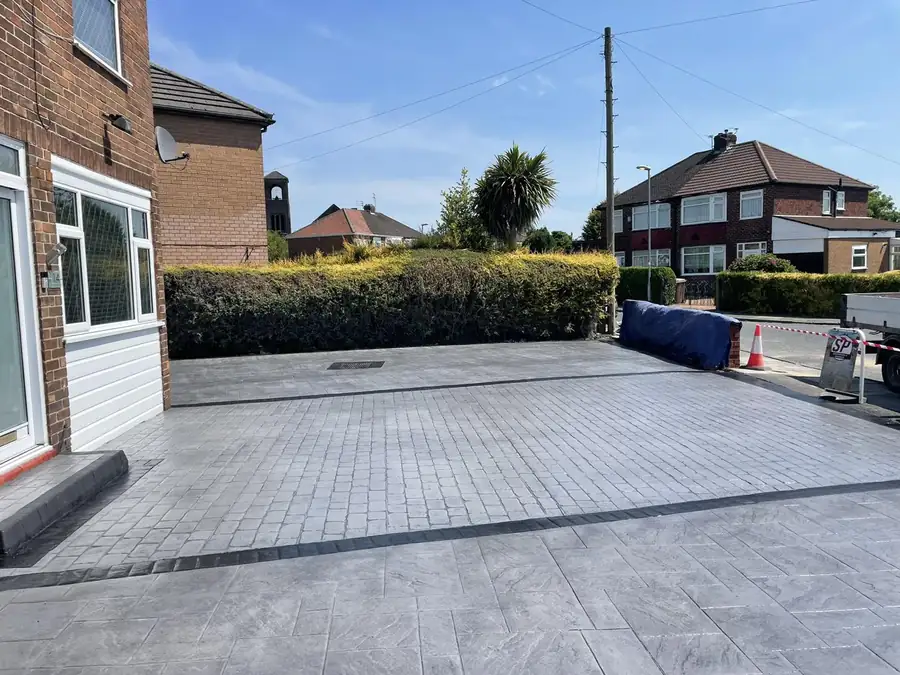
Three things follow from that. The colour lives in the top two or three millimetres, not through the slab, so anything that abrades the surface takes colour with it. The sealer is not a finish, it is the wearing layer, and it is the only thing between weather and that thin coloured skin. And because the drive is one piece of concrete rather than hundreds of separate units, it has no way of absorbing movement. A block drive that shifts a little just re-settles. A concrete slab that shifts cracks.
Why so many north Manchester drives are going at once
The timing is not a coincidence. The boom years for imprinted concrete round here were roughly 1998 to 2008, and concrete drives from that period are all hitting the same age together. On top of that, the industry was growing faster than it was training people, so quality was uneven - a properly built 100mm reinforced slab and a 75mm one thrown down without mesh look identical on day one and completely different at year twelve.
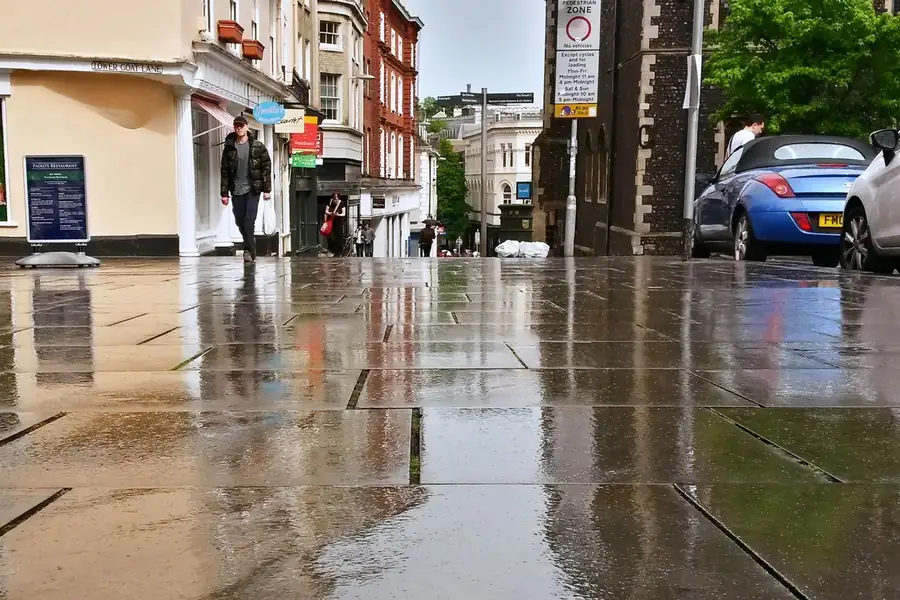
Then there is the weather. North West England is one of the wetter parts of the country, and the Met Office regional climate summaries put the region well above the England average for both rainfall and rain days. Middleton sits on the rising ground north of the city, so it catches more than the centre does. Constant wetting matters for two reasons: sealer breaks down faster when it is never properly dry, and water sitting in a hairline crack freezes, expands and widens it. We do not get deep frosts often, but we get dozens of shallow freeze-thaw cycles between November and March, and that is worse for concrete than one hard freeze.
Crazing, hairline cracks and the ones that matter
Not all cracking is the same and it is worth learning to tell them apart before you panic or before someone sells you a new drive you do not need.
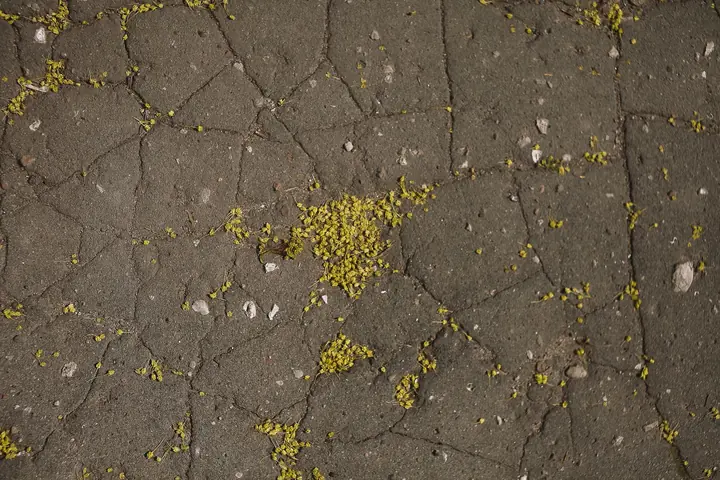
Crazing is the mildest. It looks like a fine web of shallow cracks, near enough the glaze on an old teapot, and it sits in the very top skin. It happens when the surface dried faster than the body of the slab, usually because the pour went down in wind or full sun. It weakens nothing. It does trap dirt, which is why a crazed drive looks grubby again a fortnight after it has been cleaned.
Shrinkage cracking is the next step up. All concrete shrinks a little as it cures, on the order of half a millimetre per metre, and over a 10m drive that adds up to movement which has to go somewhere. Control joints are there to give it a tidy place to go. Where the joints were skipped, or cut too shallow, or cut three days late, the slab picks its own line instead. That line usually runs corner to corner, or straight across the bit you park on.
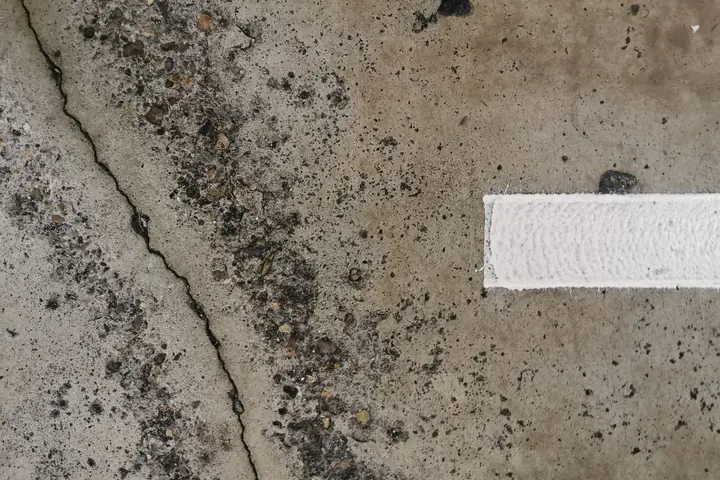
Then there are structural cracks, and those are the ones that matter. They give themselves away: wider at one end than the other, often with a step or a lip where one side has dropped, and visibly worse after a winter than before it. That is not the concrete misbehaving. That is the ground underneath, and no amount of filler will argue with it.
When the colour goes flat and the sealer gives up
The most common complaint we hear is not about cracks at all. It is that the drive has lost its colour. Owners assume the colour has washed out. Usually it has not.
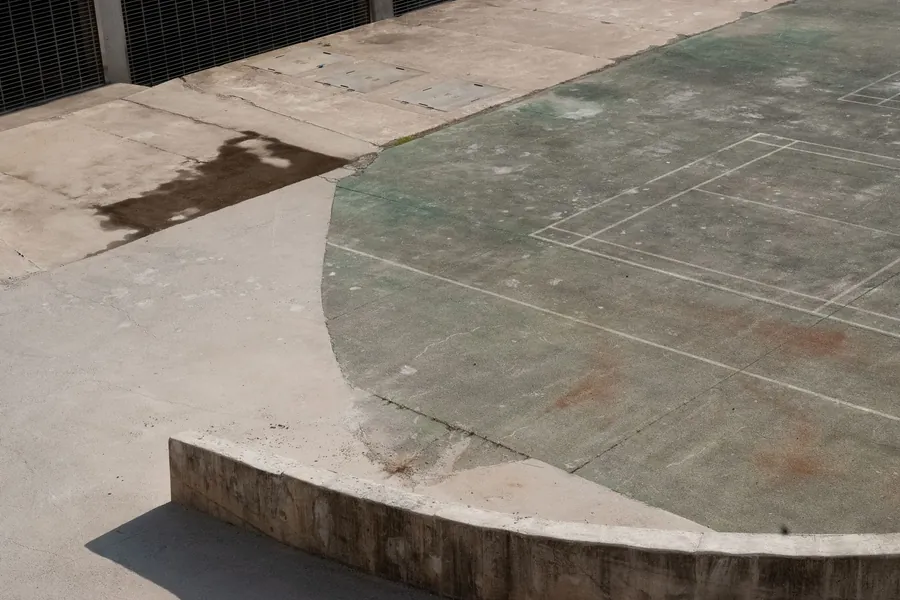
What gives an imprinted drive its depth is the contrast between the base colour and the darker release tint sitting in the low points of the texture, and what makes both look rich is the sealer. Sealer wets the surface optically, the same way a stone looks better in a puddle than out of it. Take the sealer away and the same drive looks chalky and grey even though the pigment is still there. Two coats of fresh sealer on a sound slab will bring back something very close to how it looked in year one, and it surprises people how much difference it makes.
Where colour really has gone, it is nearly always in specific places rather than across the whole drive: the arc where the car wheels turn, the strip by the gate where the salt and grit collect, and anywhere a leaking gutter has been dripping onto the same spot for a decade. Those patches have had the coloured layer abraded or acid-etched off, and sealer will not put it back.
Green film, black moss and a drive you can slip on
A worn imprinted drive in Middleton will go green. It is not a sign of neglect, it is a sign of a damp, shaded, north-facing surface in a wet part of England, and the texture that makes the drive look like stone also gives algae somewhere sheltered to sit.
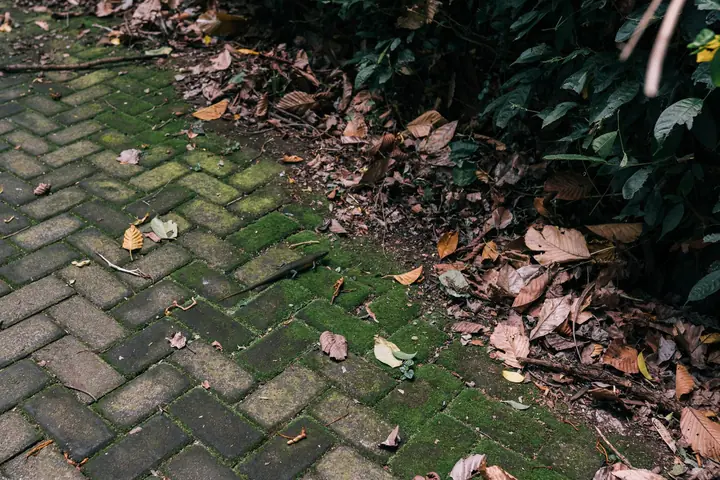
This is the failure mode worth taking seriously, because it is the one that hurts someone. Algae on a smooth sealed surface is slippery in a way that dry concrete never is, and it is worst in the exact months you are carrying shopping in the dark. Slips on level surfaces are one of the largest categories of avoidable injury in the UK, and the Health and Safety Executive’s guidance on slips and trips is blunt that contamination on a walking surface is the usual cause rather than the surface itself. On a driveway the contamination is algae, and it is dealt with by cleaning it off and then not letting it come back.
The fix is a proper wash, a biocide treatment so the spores are killed rather than just moved around, and resealing with an anti-slip aggregate stirred into the second coat. That last part is the bit people miss. Sealing a slippery drive without the grit makes it shinier and no safer.
Cracks that come from underneath
If a crack is getting worse rather than just sitting there, the problem is below the slab, and that changes what you can do about it.
Clay ground and seasonal movement
Much of the ground between Middleton and Rochdale is glacial till - a stiff clay with stones through it, left behind by ice rather than laid down by a river. Clay swells when it takes up water and shrinks when it dries out, and the British Geological Survey’s work on swelling and shrinking soils puts it among the most expensive ground hazards in the country. A drive built on 150mm of properly compacted stone spreads the load enough to ride that out. One poured straight onto dug clay, which happened a lot in the boom, has nothing between the concrete and ground that is moving every season.
Tree roots
The other underneath problem is roots. A sycamore or a cherry in the front garden, or a street tree three metres the wrong side of the wall, will send roots under a warm dry slab because that is where the easy ground is. Roots do not push concrete up quickly. They lift one corner a few millimetres a year until the slab cracks somewhere it was never designed to bend. If your crack runs roughly towards a tree, that is your answer.
Edges and joints
The perimeter fails quietly and takes the middle with it. Where a slab was poured against nothing but soil, the edge crumbles over time, water gets under the slab from the side, and the sub-base starts washing out. Control joints do something similar when they were never sealed - they fill with grit and moss, stop being able to close, and the slab pushes against itself instead. Most of what we said about driveway edging and what holds a drive together applies just as much to a concrete slab as it does to block paving.
What a clean and a reseal will actually rescue
Plenty of drives that people have written off do not need replacing. Before you get quotes for a new one, find out which category yours is in.
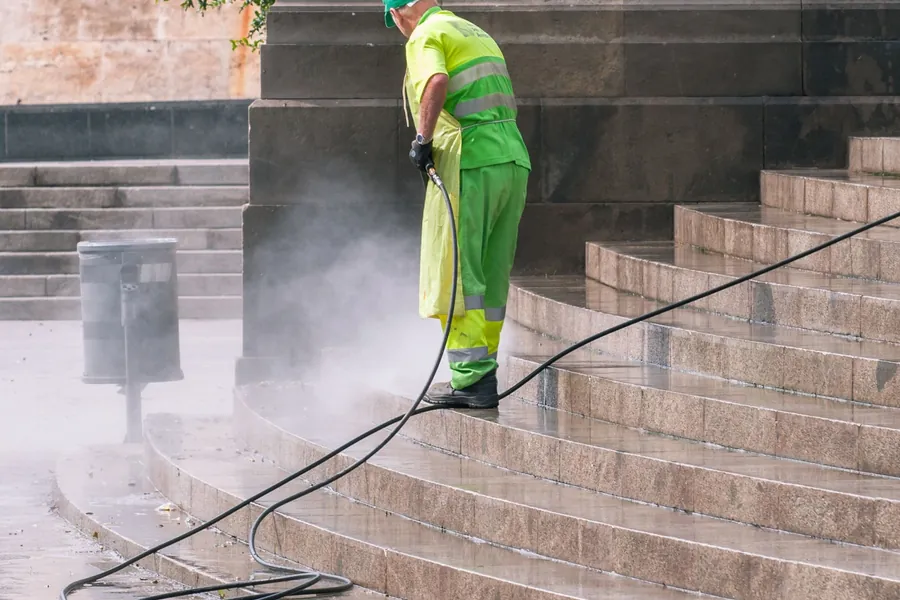
A clean and reseal will sort out a flat, grey, green, generally tired drive that is structurally fine. It will noticeably improve crazing, because a good proportion of what you are seeing is dirt held in the cracks. It will make a slippery drive safe again. Done properly it is a two or three day job: wash, let it dry right through, treat for algae, fill any joints that need it, then two coats of sealer with grit in the top one. The drive has to be bone dry before sealer goes on, which in Middleton is the real scheduling problem. Sealing over trapped moisture turns the coating milky white, and the only way back from that is to strip it.
What a reseal cannot do is fix anything below the surface. It will not close a moving crack, level a dropped section, rebuild a crumbled edge, or put back colour that has been worn off. It will not stop roots. Anyone who tells you a coating will sort a structural crack is either not looking properly or hoping you will not be.
Your three options when the slab has gone
Once the slab itself is failing, there are three honest routes, and the right one depends on the concrete rather than the budget.
Resealing and living with it is the cheapest by a distance, and it is the right call more often than people expect. If the cracking is cosmetic, the drive is still flat and the edges are intact, a few hundred pounds to buy another five or six years beats a few thousand to start again. We will tell you when that is the answer.
Resurfacing means putting something new on top of what is there: resin bound stone, a micro-topping, or a fresh imprinted layer. Over a sound slab it works well, and it costs less and makes far less mess than digging out, because the old concrete becomes the base. Over a cracked slab it is the classic expensive mistake. A thin bonded surface has no independent strength of its own, so it does whatever the concrete beneath it does, and a live crack will telegraph straight back up through the new finish, sometimes inside one winter. Resurfacing hides a crack. It does not stop one.
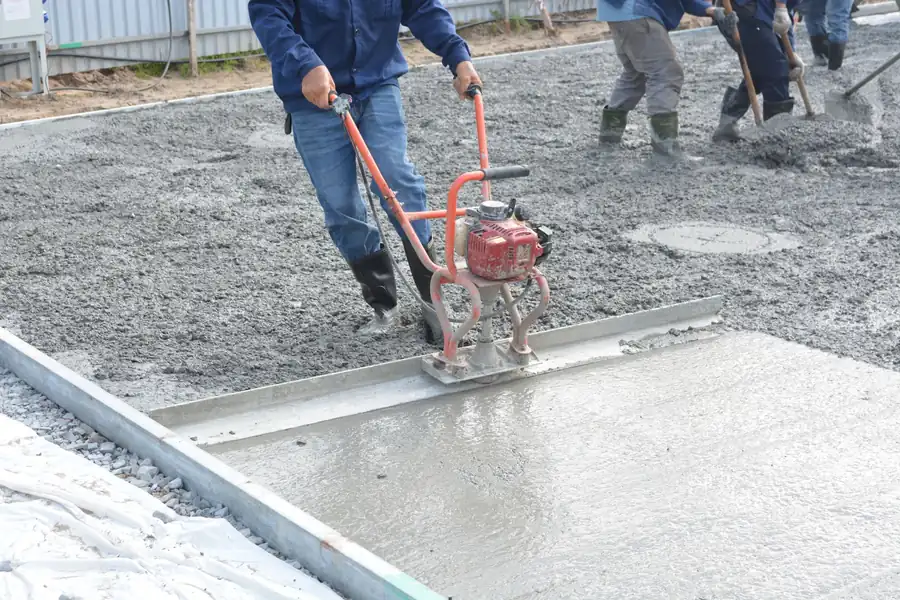
Breaking out and replacing is the only real answer where the slab has cracked structurally, dropped, or was laid on a base that was never up to the job in the first place. The concrete comes up and goes out in a grab wagon, the ground gets dug to depth, a properly compacted sub-base goes in, and whatever you choose next - imprinted concrete again, block paving, resin or tarmac - starts from ground that will hold it. It costs the most and it takes the longest. It is also the only one of the three where the problem is actually gone rather than papered over.
The way to work out which one applies to your drive is to have someone look at it who is willing to say “this only needs cleaning”. If every quote you get is for a full replacement, get another quote.
Book a free site visit and an honest opinion on your drive in Middleton
Frequently asked questions
Can a cracked printed concrete driveway be repaired?
A crack can be filled and the pattern touched in, but it will always be visible if you know where to look, because the colour and the texture were put on wet and cannot be matched afterwards. Whether that is worth doing depends on why it cracked. A single shrinkage crack in an otherwise sound slab is a cosmetic job. A crack with a lip, one that has opened over a winter, or one with several running parallel means the slab or the ground under it has moved, and filling it only hides the symptom.
Why has my printed concrete driveway gone slippery?
Two reasons, usually together. The sealer has worn thin, so the surface holds water instead of shedding it, and a film of green algae has grown in the damp. Algae on a smooth sealed surface is properly slick underfoot in autumn and winter. A wash and two coats of fresh sealer with an anti-slip grit stirred through it fixes it, as long as the concrete underneath is still sound.
How often does printed concrete need resealing in Manchester?
Every three to five years in this part of the country, and nearer three than five on a drive that gets no sun and sits under trees. North Manchester is wet enough that the sealer is doing constant work. If water no longer beads on the surface and the colour looks flat when the drive is dry, it is due.
Can you lay resin or block paving straight over printed concrete?
Over a sound, uncracked slab, yes - resin bound stone bonds well to concrete and it saves the cost and mess of digging out. Over a cracked slab it is a false economy, because anything laid thin and stuck down follows what the concrete underneath does, and the crack works its way back up through the new surface within a year or two. We check the slab before we quote either way.