
Nobody rings up asking how thick the sub-base is going to be. They ask how long the car will be parked on the road for, whether the bins can still get out, and when the kids can get a bike out on the front. Fair questions, and the honest answer is that a driveway is not one job. It is five or six jobs stacked up, and only one of them is the bit everybody pictures. A single drive in Middleton, call it 30 square metres, which is roughly what the frontages on the interwar semis around Alkrington and Boarshaw measure up at, is normally three to four working days. A double runs four to six. Anything over 80 square metres with drainage in it can stretch towards a fortnight. What changes the number most is not the size but the material: tarmac can be down and finished inside two days, while concrete will not take a car for a week after the last barrow has been tipped. Here is what each of those days is actually spent on.
Before anyone turns up with a digger
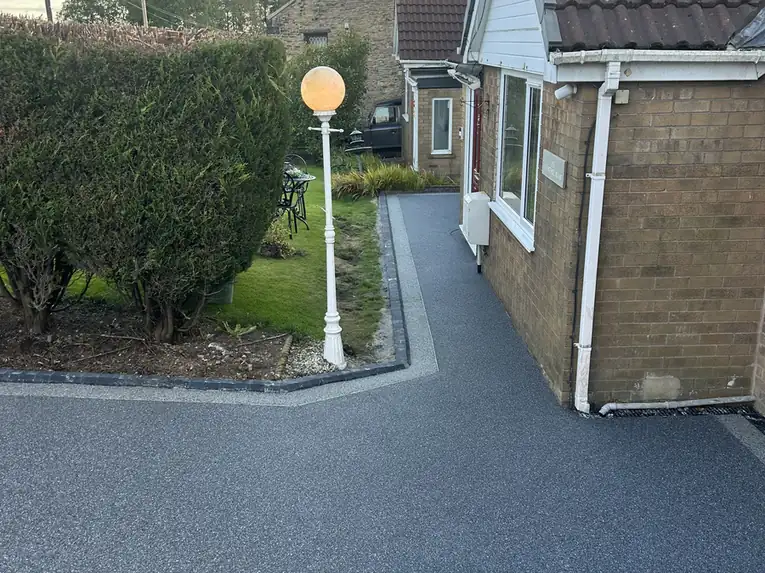
The clock does not start on the morning the van arrives. It starts at the site visit, which takes about forty minutes and is where most of the timeline gets decided. We measure the area, take levels off the threshold and the pavement, work out which way water is going to run, and find out what is under your feet. If there is an inspection chamber in the middle of the frontage, or a gas meter box at ankle height, or the garage floor sits 150mm below the path, those are all things that add half a day each and are far cheaper to find out about now than on day two.
That visit is also when the material gets settled, and the material sets the length of the job. If you have landed on block paving you are looking at a longer laying stage but no curing wait at the end. Pick concrete and it is the reverse. We put a written timescale on the quote. A start date given over the phone by someone who has never seen the front is a guess.
Then there is ordering. Stone and kerb are on next-day delivery from most Manchester merchants. Resin aggregate in a standard blend is a few days. Porcelain, clay pavers, a specific blend of blacktop or anything that is not held in stock locally can be two to three weeks, and that wait lands before day one, not in the middle of it. A dropped kerb application sits on a longer clock again, which is covered further down.
Day one: breaking out, and getting the spoil away
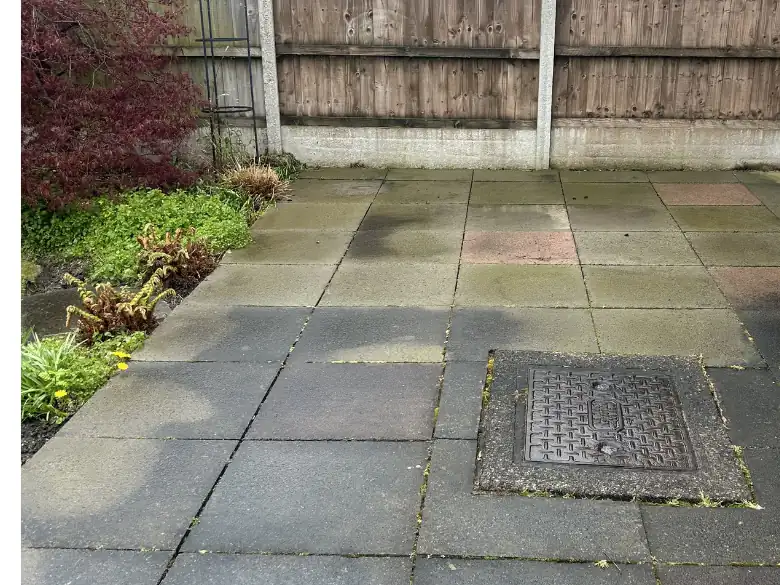
The first morning is noisy and it looks like vandalism. Old flags come up, concrete gets broken out with a breaker, and the digger takes the ground down to formation level. For a drive that will carry cars, that means excavating around 250mm below the finished surface for resin or tarmac, and closer to 300mm for block paving, which needs room for the blocks and the laying course on top of the stone.
The number that surprises people is how much comes out. Thirty square metres dug to 250mm is 7.5 cubic metres solid, and broken ground bulks up by about a quarter as it is loaded, so you are moving roughly nine cubic metres of muck. In weight, soil runs about 1.6 tonnes to the cubic metre and broken concrete closer to 2.2, so a modest single drive generates somewhere between 13 and 18 tonnes. That is two or three eight-yard skips, or one grab lorry load with room to spare.
Grab wins on most Middleton streets and it wins on time. A skip has to be dropped, filled by hand or by machine, then swapped, and on a terraced street it eats a parking space and sometimes needs a permit. A grab lorry pulls up, takes 12 to 16 tonnes in twenty minutes and goes. On a single drive that difference alone is often half a day. Where the frontage is too tight for a grab arm to reach over, we are back to skips, and the programme stretches accordingly.
Days one to two: the sub-base, and the part that cannot be hurried
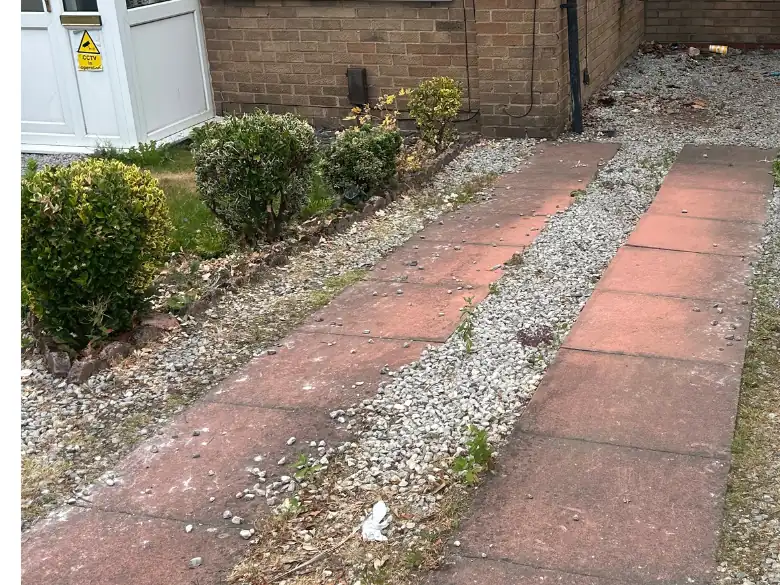
Once the hole is open, the drive gets built from the bottom up. On the clay that sits under a lot of north Manchester, we lay a geotextile membrane over the formation first so the sub-base stone and the soft ground underneath cannot slowly swap places over the next few winters. Then the stone goes in: MOT Type 1 for a bound surface, or a clean angular stone where the build-up has to drain through, as Interpave’s guidance on permeable concrete block paving sets out.
Depth is 150mm compacted for domestic cars, more like 200mm where a van or a caravan is going to sit. The word doing the work there is compacted, not laid. Stone has to go down in layers of 75 to 100mm and each layer gets the plate or the roller over it before the next one goes on. Tip 150mm in one go, run a whacker across the top and it looks identical on the day. It is not identical. The bottom half never gets the energy it needs and you get soft spots showing as dips in about three years.
On a single drive this is most of day two. A tonne of Type 1 covers roughly three and a half square metres at 150mm compacted, so 30 square metres eats about nine tonnes of stone, and every tonne of it has to be spread, levelled to the falls and rolled. There is no version of this stage that gets shorter because someone is in a hurry, and a firm that offers to do the whole drive in a day is telling you exactly which stage they plan to skip.
Edgings, haunching, and concrete that will not be rushed either
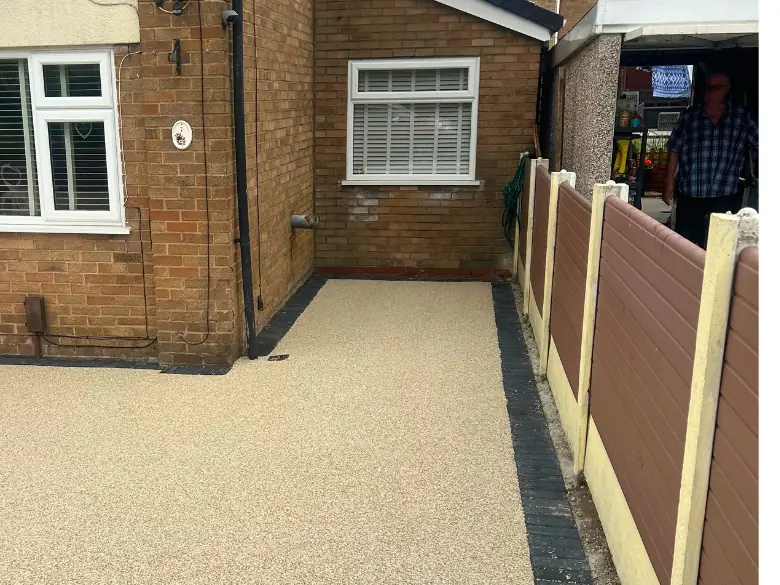
With the base in, the perimeter goes on. Kerbs, edging units or a soldier course of blocks are bedded on concrete and haunched up the back, and aluminium restraint for a resin drive is pinned down and levelled. This is usually half a day on a single drive and a full day on anything with curves, steps or a change of level in it.
Then there is a wait, and it is the wait clients query most. Bedding concrete needs to go off before anything is compacted or laid hard against it. Overnight is the normal call, 24 hours in cold weather. Push resin or blocks up against green concrete the same afternoon and you shove the edge out of line, which nobody notices until the job is finished and the front of the drive has a kink in it. We wrote at length about what the perimeter does and what it costs in the guide to driveway edging, kerbs, walls and gates, and the short version is that this is the half day worth waiting for.
We try to spend that dead time instead of losing it. Drainage channels go in at the threshold, gullies get connected, cuts get marked out. On a well-run job the curing wait is absorbed. On a badly run one it is a day the crew is somewhere else.
Laying day, and why the material decides everything
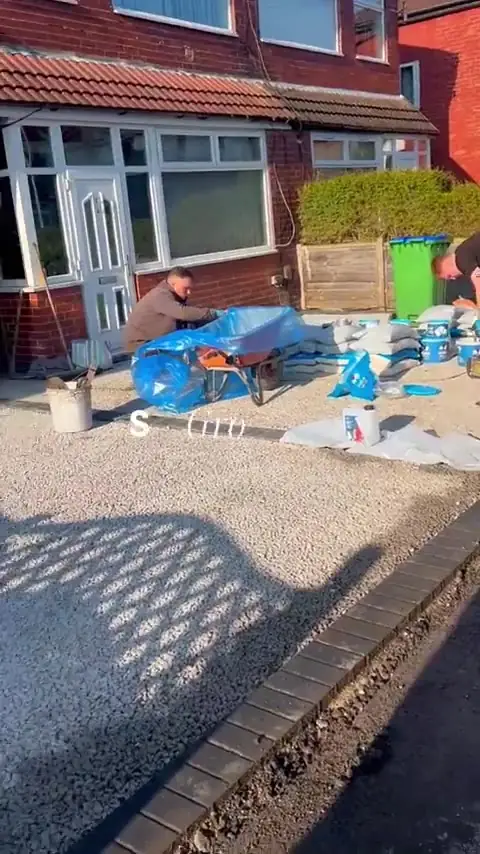
This is the stage people picture when they imagine a driveway being built, and it is generally the shortest part of the whole job. It also varies more between materials than any other stage, which is why two quotes for the same frontage can differ by two days. If you are still weighing the options up on price as well as time, the new driveway cost comparison for Middleton runs through what each one comes to per square metre.
Block paving
A two-man team lays 25 to 40 square metres a day on a straightforward rectangle, less where there are curves, manholes or a lot of cuts. Blocks go on a 30 to 50mm sand laying course, get cut in with a disc saw, then kiln-dried sand is brushed over and vibrated into the joints with a plate on a rubber mat. A single drive is one laying day, a double is usually two. Nothing has to cure, so you can drive on it that evening.
Tarmac
The fastest to finish and the fussiest about conditions. A base course of 50 to 60mm goes down first, then a 20 to 25mm wearing course, and both are rolled while hot. Blacktop leaves the plant at roughly 140 to 160 degrees and needs to be compacted before it falls below about 80, which gives a crew a narrow window from the moment the wagon tips. Tarmac gangs work fast for a reason. A wagon that turns up two hours late can write the day off. A single drive is a morning. Cold ground, standing water or rain in the forecast and it does not happen at all.
Resin bound
Resin is mixed on site in a forced-action mixer, a bag of aggregate to a measured kit of two-part resin, and each batch has five to eight minutes of working time before it starts to stiffen. It goes down 15 to 18mm thick over a bound base and is trowelled by hand. Because the mixing is continuous, area barely slows the team once they are in rhythm: 60 to 80 square metres in a day is normal. The catch is that the base underneath has to be dry, the air has to be above 5 degrees and rising, and it cannot rain on it for several hours afterwards.
Concrete
Pouring is quick, often a single morning for a domestic drive, with mesh laid in and the slab brought to 100mm or more over the base. Everything after that is waiting. Power floating or imprinting happens the same day as the pour while the slab is still workable, which makes for a long day, and then it is left alone. If you want the detail on what goes wrong when that process is rushed, the post on failing printed concrete driveways is worth ten minutes.
What actually adds days in Middleton
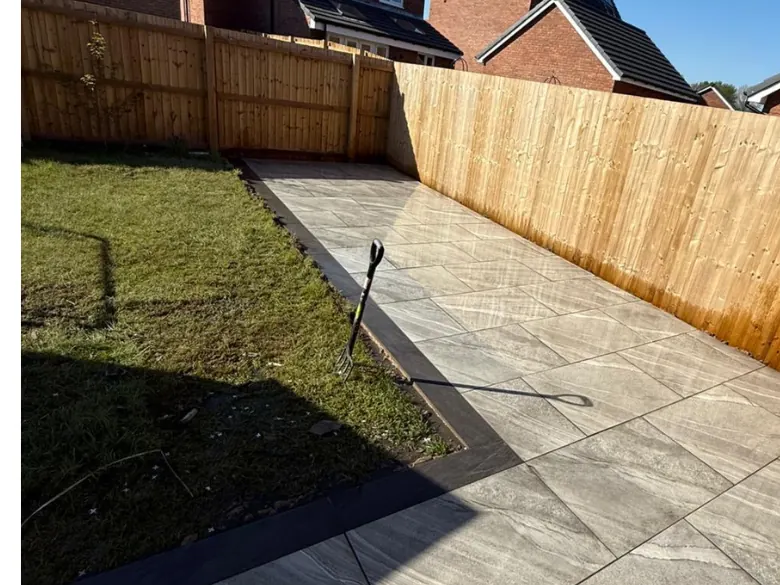
Weather is the big one, and up here it is not a small factor. Greater Manchester picks up measurable rain on the order of 140 days a year, and you can pull the exact 1991 to 2020 numbers for the nearest station from the Met Office’s UK climate averages. Between late October and February that realistically costs a tarmac or resin job two to four days of standing time in a bad month. Frost is the worse of the two, because it takes out consecutive days instead of odd ones. Groundwork carries on through all of it, so we push the digging and the block jobs into the wet half of the year and keep the hot-laid work for a settled week.
The dropped kerb is the second one, and it is the only part of the job that is not in our gift. The crossing belongs to the highway authority, and in Middleton that is Rochdale Borough Council. Its rules are specific: you need 4.8 metres of parking depth inside the boundary where the space can be driven through from both ends, or 5.5 metres where something like a wall blocks one end, and crossings can be built up to 9 metres wide where there is room to leave 2 metres of kerb line unused. Rochdale’s own guidance on applying for a dropped kerb also requires a 500mm strip of blacktop or concrete at the boundary if the drive itself is finished in anything else. The application, the quote and the council contractor’s programme all sit on their timetable, so apply weeks before you want the drive built. The wider permissions picture is in our guide to driveway planning permission across Greater Manchester.
Then there is what the digger finds. Parts of north Manchester are built over made ground, and Middleton has its share of it: old mill and colliery waste, filled hollows, and the odd pond or lodge that was levelled off and built over without much ceremony. Soft spots under an old drive mean digging deeper and bringing in more stone, and that is a day and a few extra tonnes. Ground that will not take water adds a soakaway or an attenuation crate, which is another day with a machine on site. Neither of those shows up on a photograph of the frontage. That is the argument for someone standing on it before a price is written down.
When can you walk on it, and when can you park on it
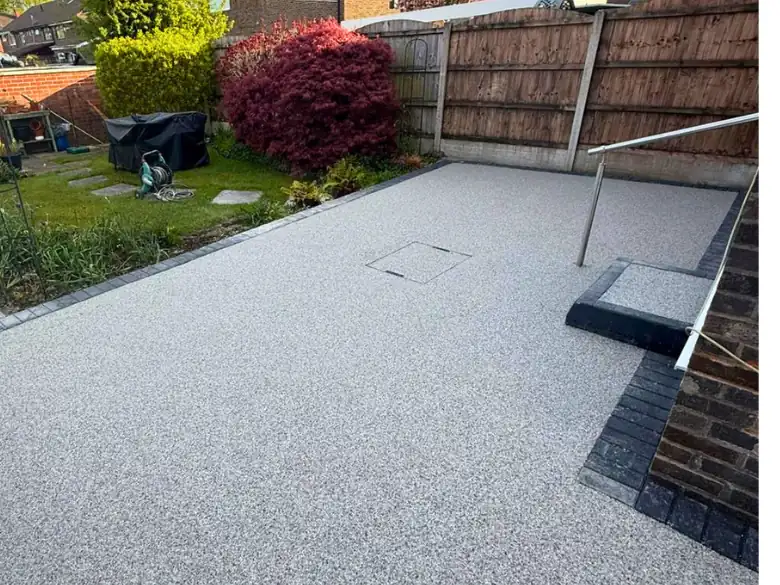
Block paving is the friendliest. Once the joints are sanded and the plate has been over it, it is finished, and you can walk on it and park on it the same day. Keep sweeping the kiln-dried sand back into the joints for the first few weeks as it settles, and top it up after the first heavy downpour.
Tarmac takes foot traffic within a couple of hours, as soon as it has cooled enough not to mark. Leave the car off it overnight and 24 hours is better. For the first three or four weeks, avoid turning the wheels while the car is stationary, because power steering will scuff a new surface, and do not put a prop stand, a ladder foot or a caravan jockey wheel on it in warm weather without a board underneath.
Resin bound is normally walkable after four to six hours in decent conditions and takes a car after 24 to 48, depending on temperature. Concrete is the one that tests patience: foot traffic after 24 to 48 hours, vehicles after seven days at the very least, and full design strength at 28 days. If a firm tells you that you can park on a fresh concrete drive on day three, that is not an opinion about your slab, it is a lack of interest in what happens to it later. Choosing between quotes on this kind of detail is exactly what the piece on how to choose a driveway company in Manchester is about.
Get a free site visit and a written timescale for your driveway in Middleton
Frequently asked questions
How long does a new driveway take in Middleton?
A single drive of around 30 square metres is normally three to four working days. A double of 50 to 60 square metres is four to six. Anything above 80 square metres, or with drainage and a retaining edge in it, runs to eight or ten days. Tarmac is the quickest to finish and concrete the slowest to hand over, because it needs a week of curing before a car goes near it.
Can tarmac or resin be laid in the rain?
No. Both need a dry surface. Tarmac arrives at roughly 140 to 160 degrees and has to be rolled before it drops below about 80, so heavy rain or a cold day kills it. Resin will not bond to damp stone and wants the temperature above 5 degrees and rising. Block paving and the groundwork underneath will carry on in drizzle, which is why we often book the wet half of the year for block jobs.
How long before I can park on a new driveway?
Block paving takes a car as soon as the joints are sanded and vibrated in, usually the same afternoon. Tarmac wants to be left overnight and ideally 24 hours. Resin bound is foot traffic after 4 to 6 hours and vehicles after 24 to 48. Concrete is the outlier at 7 days minimum, and it does not reach full strength for 28.
Will a dropped kerb hold my driveway up?
It can, because the crossing is the council's work and not ours. Rochdale Borough Council quotes and programmes each crossing with its own contractor, and it will not approve one unless you have 4.8 metres of parking depth inside the boundary, or 5.5 metres where a wall blocks one end. Apply before you book the drive in, not after.